Thursday, March 22, 2018

Rage Against The Dying of the Light

Image result for do not go gentle into that good night


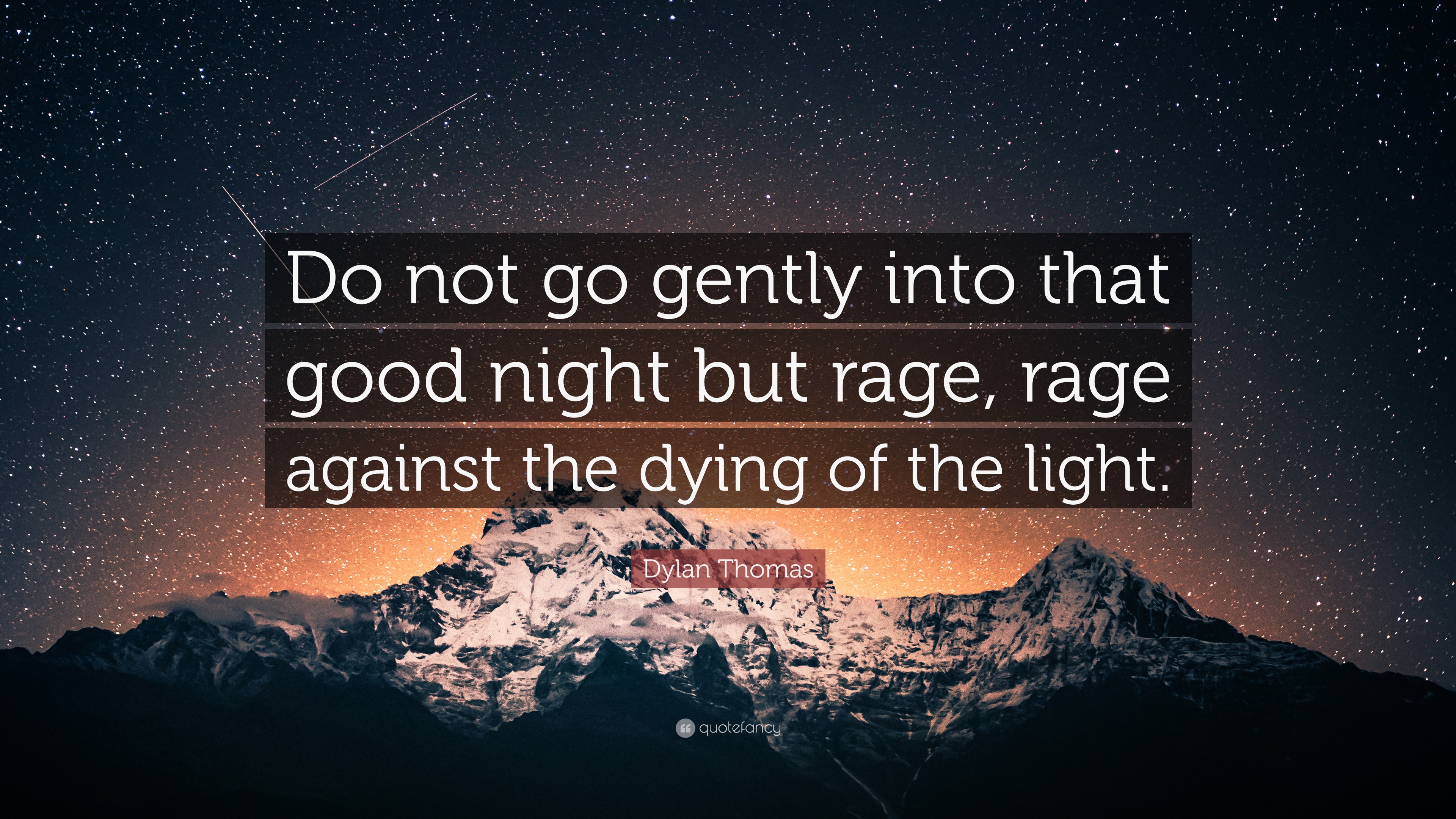
It takes courage to fight for your life, but more so to convince your loved ones to do the same. Dylan Thomas' Do Not Go Gentle Into That Good Night, is a beautiful and touching experience of the poet, who sits by his dying father, asking him to resist the end of the tunnel, and seek but the light of life in the darkest of time.


Do Not Go Gentle Into That Good Night
Dylan Thomas


Do not go gentle into that good night,

Old age should burn and rave at close of day;
Rage, rage against the dying of the light.

Though wise men at their end know dark is right,
Because their words had forked no lightning they
Do not go gentle into that good night.

Good men, the last wave by, crying how bright
Their frail deeds might have danced in a green bay,
Rage, rage against the dying of the light.

Wild men who caught and sang the sun in flight,
And learn, too late, they grieved it on its way,
Do not go gentle into that good night.

Grave men, near death, who see with blinding sight
Blind eyes could blaze like meteors and be gay,
Rage, rage against the dying of the light.

And you, my father, there on the sad height,
Curse, bless, me now with your fierce tears, I pray.
Do not go gentle into that good night.
Rage, rage against the dying of the light.


He brings a comparison between men of all kinds, as every man has reason to fight for dear life. The gift of life, he explains, is a blessing, and one hold onto it till its last string.

Wise men, he says reckon there's more to life, awning for achievements that they have yet to make. They believe there is more they can do with their wisdom, hoping there's a chance of making a difference to the world, or to someone's life. They believe they mustn't let go of their life so soon, for their intelligence and wisdom still has the potential to do good, and therefore, they would fight against the end of life, for the chance to fulfill their destiny.

Good men, seek to do better, says the poet. At the brink of death, good men think of the good deeds they are yet to do, and how the little tasks they set out to do, make a beautifu difference to this world. While at the gate of darkness, they resist its calling, to better the world around them, with their good intentions, and sweet actions. The goodness in them shall fight, fight to do better whilst they still have a chance; and threfore they shall not leave without a fight.

Wild men, says the poet, have plenty they still wish to do. They lived their life in splendor, and missed their youthful rigor towards the end of their lives. As they enjoyed their life through the bright phases of their life, they turned sad as the days of their lives turned dim; and now they seek a chance to have changed that attitude and live their life with the same vigor they once did. They bid the approaching death to stay away, as they must seek what they once has and live the life they once enjoyed, yet again.

Grave men, he says, who saw the world in its greyest light, look bright and wide through the dying light, regretting the sadness that governed their life, and viewing what's left with the brightest shine. With the end approaching, they wish to rectify their actions, and be more optimistic towards life. They aren't ready for the end just yet, and will fight to live a happier life than what they did. It is time, they believe, to see through their 'blind eyes' the world that they had missed on, due to their serious old self. It is time to fight.

At the end, the poet looks to his father, and pleads him to 'curse, bless' him, using this oxymoron to initiate some exchange of words between, of any kind. He has forgotten all the differences between him and his father, as he looks at his frail self on the death bed, asking him to fight, fight for dear life,fight for another breath, fight for the vigor he once had and for the million things he could still do. He pleads his father to rage against the dying of the light, for like any man, there is always something to fight for.


And so should you...

Thursday, March 15, 2018

La Vita e' Bella!

Life is Beautiful, a film


Related image


This week I write about one of the most tragic deaths from the cinematic universe. 

In 1999, a piece of art was released as a film called ‘La Vita è Bella’, an Italian film, that can be translated as ‘Life is beautiful’. It soon became a worldwide sensation, and the story and skill of both, the actors and the director were soon celebrated as phenomenal.

The film is based in the early 1930s, in a little town of Italy, where Guido, our protagonist (played by Robert Benigni), arrives to find work as a waiter in his uncle’s hotel. As the fates may have it, on the way to the hotel, he stops for a minute, and in his arms falls a beautiful teacher of the city school, stung by a wasp. “Goodmorning Princess!” He exclaims, and it’s love at first sight - for both. 

A serious of events lead to several ‘chance encounters of the same kind, an unexpected date, the most genial kinds of flirtation and the most romantic lines that the English subtitles can barely do justice to. 

He elopes with her before her wedding to another man, and the movie moves to the future, introducing their little son - the most adorable child actor/ role I have seen in any movie. The earlier romance transitions to a marvelous father-son relationship, that any viewer might admire.

Fates weren’t as generous on Guido’s litter, being born as a Jew. Guido and his son are soon caught for their Jewish blood, and taken to camp; and his wife decided to join them. While this all would be haunting for a kid, the rest of the story is how Guido makes it feel like a little game for his son, making him laugh, getting him to make friends with other German kids, promising his son that this was a vacation he planned for his birthday. He promised his son that if he gets through this game smiling, he would get a tank as a reward.

As the war came to an end, so did Guido’s journey. As we celebrate the freedom of it characters, he is shot by one of the guards, while his son is out in the city, hiding in a little closet for his father’s game. When he finally comes out, he is face to face with an approaching British Tank, with a smiling soldier who offers to take this lone child to his family. 

In the child’s mind, his father was always right. The ‘fun game’ his father created finally ended with a Tank! And you have nothing but respect for Guido and his love for his son. Guido’s death could make the toughest of persons cry, because his character warms your heart. It is a common fact among the viewers of this film, that this was one of the most tragic deaths in cinema, and to me, personally, it was the end of a brilliant being. For a man who can make a concentration camp fun for his son, I hold nothing but reverence.


Related image

Thursday, February 22, 2018

Explaining the existence of this blog

This was called for...

Image result for picture of someone happy in a field
A generic picture of someone "living their life" courtesy gettyimages


A while ago, last semester, I published a survey on what people are afraid of, when it comes to the topic of death; and who or what would they miss the most/regret before their last breath. As it turns out, by sending out this survey on groups, I appeared suicidal in the eyes of the Res-Life Coordinators, who requested several meetings to comfort me and stop me from killing myself.

While I appreciate their concern, their attitude towards my survey worries me slightly. For asking my peers what scares them about death, I wished to get in a conversation that would aid their fears – allowing them to live more freely and realize that the inevitable is nothing to be afraid of, let alone hamper your present.

This survey was also supposed to encourage a thought of making the best of your life. Several individuals, in the survey, confessed their regrets and the need to express their feelings or do something one last time. To the reader of this blog, I request you to live! The intention of this blog is to reduce your inhibitions and live life to the fullest! In no way do I intend to desensitize you to the importance of life, but reduce the intimidating gleam of death that shadows most of our actions.

For those who answered “I will miss my dog”, I urge you to facetime them tonight. For those who would miss their parents, text them before you go to bed. For those who want to travel while they can – save up and plan! Work towards the fulfillment of your life, motivated by the possibility of death.

I was eventually put in front of a board, to assess my mental stability (sigh). They assessed my reasoning behind having a blog such as this. Having understood that this was done with good intentions and not to incite suicidal tendencies in my peers because ‘I myself might have it too’ (yes, they thought as well), they finally let me be.


I am happy with my life, and living it to the fullest (I have at least one dessert a day). I hope you do too.

Wednesday, February 14, 2018

Tale of a Cat that ruled my heart

A Cat called Zander

This post is about one of the most beautiful relationship I have had in my life. It is funny to think sometimes, how strangely attached we get to animals. There is a sense of comfort and relief in sharing your space, your emotions, and often your secrets with our little pets. People usually entrust this affection unto dogs, the commonly adored pets - who, for people like my girlfriend, have the power to fix any problem, just with their smile (and licks of course).

My heart, however, goes out to the feline kind - cats to be specific. Their carefree, mischievous, lazy and bold demeanor resonates extensively with my own self. While many think that cats are not affectionate, they are one of the most sensitive beings I know. They just have a different way of showing it. They aren't the needy kinds, but they are indeed affectionate.

As is obvious, I had a cat. Judging by the nature of this blog, and the tense of my sentence - yes, he isn't around anymore. Is he dead? I don't know, but he is always, always, always in my heart (and in the beautiful picture on my nightstand). He wasn't actually my cat, he was my host family's back in Italy - during my year long exchange program in Sardinia, Italy. Before I headed there, I had never had a pet, but I was looking forward to having one.

They called him Seth, a grey stray cat that once found its way in my host mother's car. He sniffed me a couple of times, let me pet him in a week, and within a month he was often curled between my legs, definitely more comfortable than I was. He would often take sips from my glass of wine, finish my crumbs from my pizza, bring me a trophy rat occasionally and get into fights with other cats and come back crying for love.

He was a brave wild cat who would always roam the neighborhood; and we would let him. At eight years old, he would jump off the balcony, fight cats twice his size and keep all his messy business outside the house. He would enjoy his life on his own, until eventually he got hungry and came meow-ing outside my door. There was something magical about him - as if he was speaking to all of us telepathically.  He would often come in my dreams and speak with me - telling me his name is Zander. Turns out, he had done so to my host brother as well. Sounds insane, doesn't it? But well, I never cared. In moments where I felt more closer to him, I would address him as Zander, and he would respond by rubbing his head on my knees and curling close to my legs.

Before my last month, I whispered in his ears that he would only have me around for another month. In eight years he had never climber anyone's bed (he was very civil that way). But after that day, he gave me company in my bed every single night. It was a small gesture, but it's in these small ways that cats reach your heart.

I missed him after I left, missed him loads. So much so that I went back to Italy after a year. By now the house had 4 more cats, recently introduced and openly despised by Seth. Exactly a year since I last saw him, I saw him again. He had just had a meal and was about to walk out when I called out his name. He turned, looked at me, walked back slowly and rubbed the back of his head on my knee. When I looked at him again, he had tears in his eyes, with the most heart-warming expression; then he ran out of the house on his business.

I later found out, that was going to be the last time I saw Seth. Turns out, that was the last time anyone saw Seth. He never came back. He was out in the open, enjoying the neighborhood - something that he always delighted in doing. Do I miss him? Sure. But I always hope that he is alive somewhere, having a filmy holiday in some kind of cat paradise. Or if he did die, I just hope he is in the real paradise, because a cat as lovely as him deserves no less.

Wednesday, January 31, 2018

The Last Letter of Columbus

Reminiscing the once living

Earlier in 2017, I participated in a competition. It was about writing an autobiographical letter from the grave of a famous historical figure (from a given list). This was my take on Sir Christopher Columbus's Last Letter.


Thursday, January 25, 2018

What happens when you play with life?

Flatliners: A scientific and moral approach to death


Image result for flatliners
Official Poster

This week on death, is a review of one of the most recent movies on the concept of death and what lies after: Flatliners. The movie, released on October 19, 2017, is a story of a group of doctors, attempting to study brain activity at the time of, and after death.

Following the idea of Dr. Courtney (played by Ellen Page), each of the doctors, one by one, put themselves in a state of death, for varying minutes of time. An experiment, meant to analyze synaptic reactions exactly at the time of death, turns into a thrilling activity with outcomes like academic superiority, exemplary memory, skill development and high intuitive abilities. Seeing successful reactions in some of the doctors, the other doctors set out to partake in the experiment as well, competing to ‘stay dead’ longer than the others, hoping for better results.

As four of the five doctors go through the process, the side effects start to surface. They call the process ‘flatlining’, based on the heart rate monitor going blank at the time of death. As these ‘flatliners’ enjoy the benefits of their experience, they are faced with the remorse of their past sins. (Karma, anyone?) They begin to hallucinate the presence of those they have wronged, and these visions threaten to take their lives.

In the midst of these situations, the doctors realize that the only way to end these hallucinations (that claims the life of Dr. Courtney), is to put their sins to rest. Each of them set out to rectify the errors of their past, be it by finding the person and apologizing, or by traveling back to the land of dead and paying for their sins (it was as dramatic as it sounds). At the end, the story of scientific discovery ends in a tale of morality, that reminds you that nothing hurts more than remorse, and to apologize and repent is the only balm to the aches of our sins.

The movie was a fascinating take on the concept of death, approaching it from both, a scientific and moral point of view -  definitely recommend it.

Don’t forget to apologize to those you have wronged, or their ghosts would haunt you. Better so, wrong no one!


Wednesday, November 15, 2017

What's death to you, PennState?

Survey on people's perception of death

Over the last week, I tried to find out the view of PennStaters and how they perceive the idea of death. Over my past few blogs, I spoke about different ways people died, different theories for the afterlife, the art in death (gravestones) and the different cultural traditions involved all over the world. It made me curious towards the end to know how people around me view the 'concept' of death.

This survey, conducted using the help of Survey Monkey, had 2 simple questions:
1. List 2 reason why you wouldn't want to die
2. Are you scared of death? (Feel free to explain)


I received 60 responses for this survey, some expected answers, some silly mischief and some sentimental responses.

For the first question, the popular reasons followed the following order:
1. Family & Friends (30 people)
2. Wanting more out of life (13 people)
3. Fear of the Afterlife/Unknown (4)
4. Curious about the future (3)

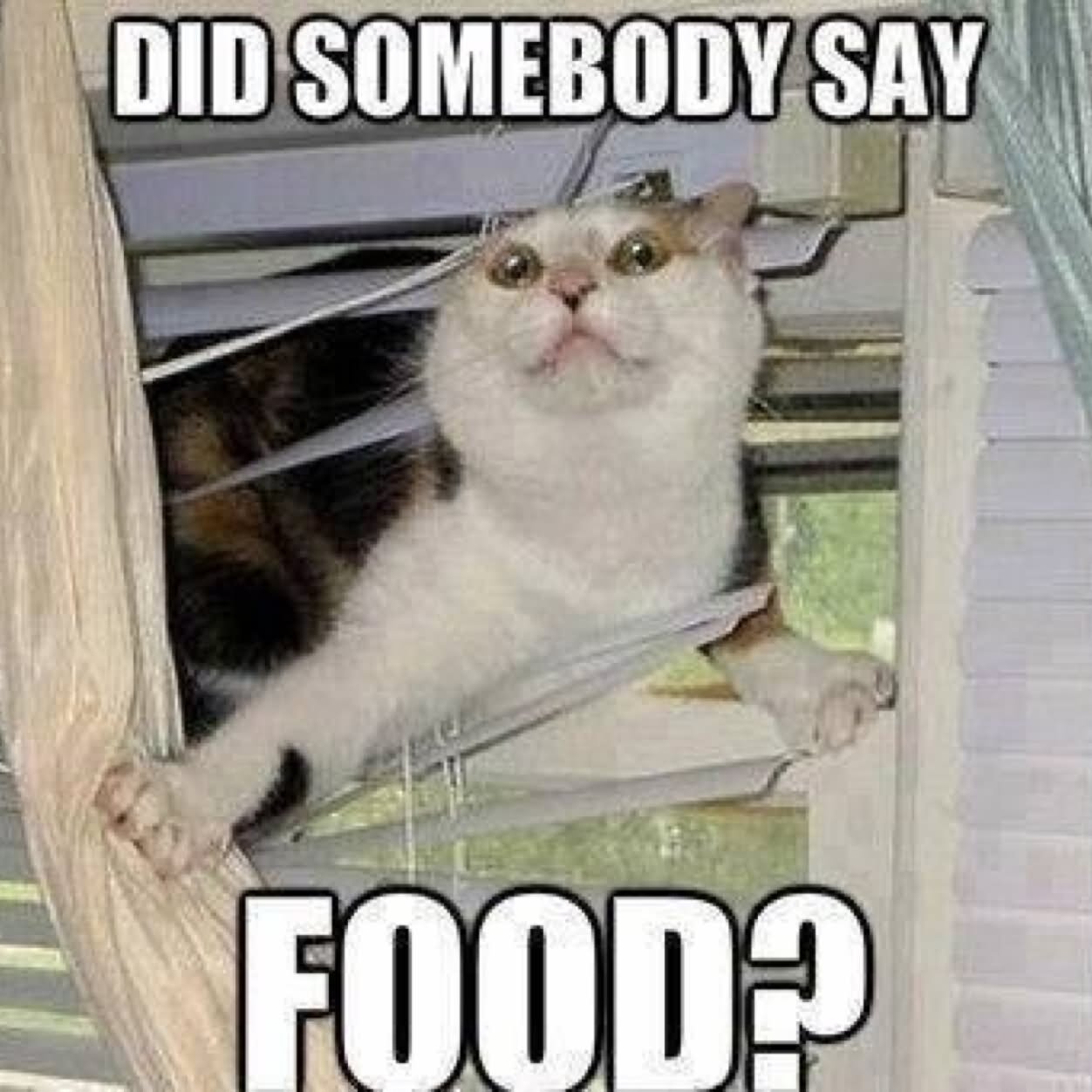
There were some scattered responses such as food, kids, "waiting for my iPhone X", specific names and the best: memes.

Image result for damn right meme
Quickmeme Images
As their second reason, people listed a varied variety of responses, much more interesting then the first one. They followed the following order:

1. Wanting to see the future
2. Wanting to be a parent
3. Fearing the pain involved in dying
4. Love life
5. Love my pets
6. Missing people and moments

Again, there were some random answers, related to personal aspirations, specific names of people, ambitious plans and food

Image result for love food meme
askideas.com

.
The order of these answers shows how most people thought first about the pain their death would inflict on others, than the pain it would cause themselves. Their first thought/response was about fears and regrets they might have, followed by the fact that they actually like the life they are living and wouldn't want it to end. It was interesting to note how people think first about others; showing how empathetic people can be - Except this one person who gave the following answer:


The second question was more straightforward; "Are you scared of death?" The participant had to simply choose between a Yes or a No, and could add a comment to explain their answer.

Astonishingly, there was not a big difference in these responses:


It was my initial expectation to find most people fearing death, with a ration of about 7:3. While most people did accept that they feared death, quite a few claimed to not fear it at all.

Most reasons for people to fear death, as I expected, was the fear of what was to follow. They thought it would hurt to die, hurt to leave everything that you have worked for all your life, and to leave all close to you behind.

The reasons most people did not fear death, was due to its inevitability. Most answers looked something like this:


Some students were evidently fooloing around, with a concerning reply as this:


While some students had responses influenced by their religious views, like this one:


I was happy with the results of this survey. Quite a few students participated, and their responses seemed genuine. Most answers were as expected, which shows how much people, even students in their teenage years, are concerned by the uncertainty of afterlife, and the regret of not having done. It is a reminder of the famous saying, "Seize the day!"

With this last blog, if you are reading this, I'd like to remind you to tell yourself this everyday, "Forgive and give as if it were your last opportunity; Love like there's no tomorrow, and if tomorrow comes, love again." - Max Lucado. Then again, don't fear the inevitable, let it motivate you till the very end.

Wednesday, November 1, 2017

A Menu full of Funerals!

What happens between the before and after?

We frequently talk about the afterlife, and overhear the various ways people around the world have died/ are dying. Not only have I spoken about these two things in my past blogs, but they are also widely spoken conversations (as common as they can get without making one appear 'creepy). We barely hear about how people deal with the dead - not emotionally, but literally. Perhaps because it may be a gruesome, or slightly insensitive topic to discuss. However, it is interesting to note how people across the globe have mostly similar, yet certain varying forms of dealing with the dead, for religious, practical or other prevalent traditions.


Iran

Image result for iran
Fox6now
 Being a Muslim dominant region, the kind of burial service is elaborate. Following strict procedure, the deceased must be buried within twenty-four hours, after being washed 9 times! People often gather around the coffin, while it is being transferred to the cemetery. It is considered holy to have either helped to carry or touched the coffin while it is being moved. While the crowd chants verses from the Qu'ran, the coffins are all buried facing the Mecca, the holiest place on Earth according to Islamist beliefs.
  
The mourning too is well defined, with strict steps and procedures set for the next few days: a memorial service on the 3rd day, a visit to the grave on the 7th, resuming to wear normal clothes and placing a gravestone after the 14th.


Mongolia

Image result for mongolia
Encyclopedia, Brittanica
Mongolians are widely Buddhist, and therefore follow the Buddhist concept of dealing with their deceased. While some monks are given a cremation, the Mongols in general are left out in the open, on a high plateau, to be devoured by nature and its elements. It is a form of respecting the deceased after the unfortunate event.

It is said, that accessories that the individual often retained with himself/herself when alive, would perhaps be retained by the soul. The family needs to therefore seek that item, and get rid of it (via destruction, or by handing it over to someone else), to avoid any bad luck,


South Africa

Image result for south african funeral
SA, Funeral Supplies
Burial and mourning style of this continent are a blend of modern and traditional practices. The body is cremated after being deceased, the ashes are applied to the windows, bed sheets are changed, and at times, following ritual, an animal is sacrificed. 

What follows is an 'After Tears' party, where the mourners get drunk and joke, to comfort relatives of the deceased, and to remember the deceased with fondness.


Sweden

begravningskonfekt_tro_hopp_karlek_samt_grav
Funeral Candies
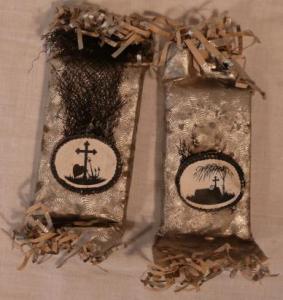
Swedish burials are very personal, with only immediate &close relatives present (if at all). The burial happens between one and three weeks, with songs being sung next to the grave, and white ties worn by men. For years together, 'Funeral Candies' were an important idea too, where candies were handed out, in the shape of a coffin (with it changing in look after being for a younger/older person). They would even be slightly ornamented with silver or gold paper. However, these candies are today phased out.


South Korea
Image result for south korea funeral beads
SevenPondsBlog
 In South Korea, the deceased are changed to a piece of ornamentation after their unfortunate death. Their bodies are compressed, the pressure changes them to small gem-like beads of varying color, usable as decoration/ and remembrance, as these beautiful gem-like beads can be used to decorate parts of houses.


Philippines

Image result for caviteno tree burial
Caviteno Tree Burials (SevenPondsBlog)
The people of modern Philippines have several different burial customs that they follow. 

The Tiguanian people particularly make the dead look alive, with hats and cigaretters.The Caviteño buried their deceased in hollowed out tree trunks!The Benguet of Northwestern Philippines blindfold the face of the deceased before they are buried.The Apayo would bury their deceased underneath their kitchens!


Zoroastrians

Image result for zoroastrianism
Symbol of Zoroastrianism (CiteLighter)
Followers of this faith have a peculiar and specific method of dealing with the corpse. It is first washed with bull urine. After that, it is made to be visited by a Sagdid, a funeral dog (metaphorically), that scared the evil spirits away. Finally, the corpse is placed in a tower of silence, to be preyed upon by the vultures. This completes a 'food chain' for the people of this section,


These were some of the very different forms of 'tending to' the dead, other than the commonly known cemetery burials and cremations practiced by most of the world. Traditions have no limits!


 Works cited


JR Thorpe, Jul 14, 2015, Bustle, Interesting-death-and-funeral-rituals-around-the-world-from-mongolia-to-sweden

March 4, 2017.,"Mongolian practice of burial". www.welcome2mongolia.com.

Funeral. (2017, October 28). Retrieved November 02, 2017, from https://en.wikipedia.org/wiki/Funeral


Thursday, October 26, 2017

Why dying can be funny (not for the dead ofcourse)

The Weirdest Ways to Die 

While the concept of death is meant to be sad and painful, the death of certain individuals in the past have been a major source of laughter, simply because of the hilarity/absurdity of the way they died. This post is not meant to ridicule the dead (rest in peace folks), but to only 'admire' the different ways that people have adopted to meet their maker.


1. The London Beer Flood 

I can hear the beer lovers shout in excitement - but it wasn't as fun as it sounds. In 1814, a giant vat in a brewery burst open, causing a domino effect that burst the surrounding vats open too. It led to 323000 imperial gallons of beer to flow into the streets, flooding the neighborhood, destroying some homes, crumbling a local pub (trapping an employee inside).


Image result for london beer flood
Pic curtsy the Snake River Brewery

8 Londoners died in this beer tsunami, either by drowning or injuries. This catastrophe was called God's displeasure towards the alcohol culture.


2. The Rocking Pool Party

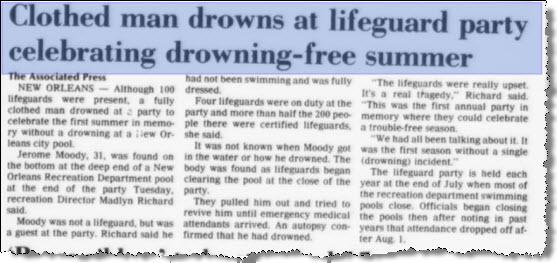
In 1984, the New Orleans lifeguards through a lavish pool party to celebrate their first 'drown-free' swimming season. Sounds lit, right? Well, irony didn't think so. The party was a rocking success, until a non-lifeguard guest at this party, 31 year old Jerome Moody, drowned. There were 4 lifeguards on duty and about a 100 guests were lifeguards themselves, but no one could save the drowning young man.


3. The death of a victor

  • If someone asked you to guess how you’ll one day die, chances are you wouldn’t say ‘infection caused by some really trivial minor screw-up’.
  • But that’s exactly what happened to ninth-century Norse warrior, Sigurd the Mighty, who, after emerging victorious in combat, strapped his enemy’s severed head to his saddle and rode home. He ended up grazing his leg on the exposed teeth and died from the ensuing infection.
  • Moral of the story kids: Pride can kill you.
  • Image result for sigurd the mighty
    Viralnova, Pinterest
4. The Dancing Epidemic


  • In 1518, a woman stepped into the streets of Strasbourg City and started to dance. Several days later, she was still at it, and hundreds joined in. This was the first of what became Europe’s compulsive dancing outbreaks.
  • Authorities believed the affliction would pass if the affected danced it out, Napoleon Dynamite-style, so halls were made available and musicians were hired. Days passed, but none quit. Eventually, people dropped dead of sheer exhaustion.
  • It took months for the epidemic to recede, and the afflicted had to be loaded onto wagons and taken to a healing shrine. It’s believed this mass hysteria was caused by extreme famine, disease and spiritual despair.
Related image
A 1642 Engraving by Hendrik Hondius portrays three women affected by the plague.

5. My damn cough

Napoleon Bonaparte, the famous French soldier had many a great feats pinned to his collar. However, there are some stupid stains there too. Once, affected by a serious case of cough and cold, he sneezed out loud and cursed, Ma Sacre Toux - which means 'my damn cough'. His officers, however, heard something completely different. They heard him say, "Massacre-tous", which means massacre all. 


Image result for napoleon bonaparte

This 'misunderstanding' cause the execution of a 1000 soldiers. Oops.


6. The Fatal Beard

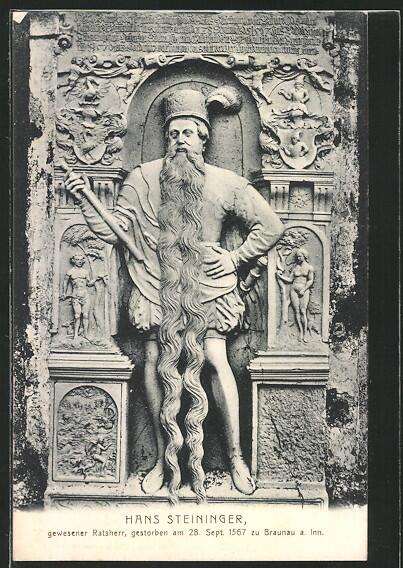
Austrian dude, Hans Steininger, was famous for two things: 1) Having the longest beard in the world (then, 4 feet and 2 inches long). 2) Dying due to the long beard.


Image result for hans steininger

In 1567, there was a fire in Austria. In his haste, Mr. Steininger, forgot about the length of his beard. He forgot to roll it up, tripped on it, broke his neck, and well, died.


7. Death by a Healthy Diet

  • Related image
  • Basil Brown was a UK health fanatic who managed to drink himself to death with carrot juice. He reportedly drank more than a gallon of the sweet stuff a day, believing it would give him x-ray vision – or just generally make him healthier.
  • He ended up guzzling over ten gallons in ten days, which gave him ten thousand times more than the recommended amount of vitamin A and, ultimately, led to fatal liver damage. Moderation, folks.

8. The paradox of Marcus Garvey's death

Marcus Garvey 1924-08-05.jpg
from George Grantham Bain Collection
Garvey was a proponent of Black nationalism in Jamaica and the United States. On 10 June, 1940, he read a fake obituary of himself which called him "fake, broke and unpopular". He hated it so much that he had a stroke and died.


9. The Kiss of Death

A 20 year old, Myriam Ducré-Lemay went to a Montreal party with her boyfriend back in October 2012. They had a great time, until, well, she died. How? Her boyfriend had enjoyed a hefty meal of scrumptious peanut butter sandwich at the party. Little did he know that she had a severe nut allergy, and his 'little kiss', would end up as a kiss of death. 

Not Released (NR)


10. The Snake Charmer

Cartoon by Darwin Awards

In 1997, Wayne Roth of Pittston, Pennsylvania, was bitten by a cobra belonging to his friend Roger after reaching into the tank to pick the poisonous snake up. 
“I don’t need to go to hospital” Wayne apparently told Roger. “I’m a man. I can handle it.”
Instead, on Wayne’s suggestion, the pair headed to a pub instead. There he proved what a man he was by sinking several pints, boasting about the bite, and promptly dying about an hour later.
Cobra venom is, it seems, a slow-acting toxin which takes several hours to attack the central nervous system.
What a guy.
Which way would you die? :)

Wednesday, October 18, 2017

The Paradox of the Afterlife

If I live after I die.... Do I never die ??
Naza Gif


It is, perhaps, the biggest mysteries of our life - what happens after life, as we know it, ends. For multiple millennia, several theories have existed, with people especially in the past, strongly believing in life after death. Whether it was reincarnation, heaven and hell, or rising in the spiritual hierarchy (a.k.a closer to God) - the beliefs are plenty. It is also one of the primary reasons why we have different ways to dispose off a corpse, either by burial, electrocution, cremation etc. for these are all in lieu of the 'life the dead would live after they die'. Paradoxical? Damn right.

We are all generally aware of the ideas of Heaven and Hell; it's common to most of the religions, just known as different names. However, there have been way cooler, diverse, and low-key crazy theories that have prevailed/are prevailing in our world. Let's take a look:


1. The Egyptians

The Egyptians took their dead seriously. They practiced the expensive and labour intensive art of mummification, as that was the only way to have an after-life. This method preserved bodies so well, that they can be viewed even today, in a relatively normal conditions. Entry to the 'Afterlife Park' was demanding. It obviously required a sin-free heart and the ability to recite the spells, passwords and formulae from the Book of the Dead. In the Hall of Two Truths, the deceased's heart was weighed against the Shu feather of truth and justice taken from the headdress of the goddess Ma'at. If the heart was lighter than the feather, they could pass on, but if it were heavier they would be devoured by the demon Ammit. No Big Deal. 

Related image
Weighing the soul of the deceased

To help them on this journey, families generally left food, jewelry, a copy of the Book of the Dead, painted gateways inside the sarcophagus (intricate coffins) that lead the soul to the afterlife. 

Related image
Next flight to After Life leaving in T-2 minutes.
They mummified animals too.


2. Islam

Image result for islam afterlife


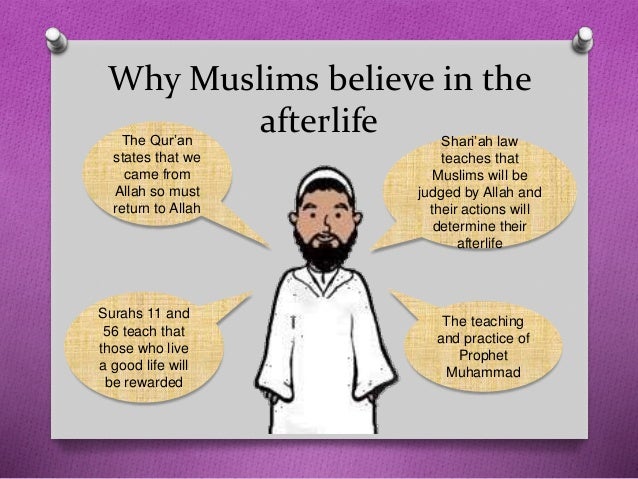
A central doctrine of the Quran is the Last Day, on which the world will be destroyed and Allah will raise all people and jinn from the dead to be judged. The Last Day is also called the Day of Standing Up, Day of Separation, Day of Reckoning, Day of Awakening, Day of Judgment, The Encompassing Day or The Hour.
Until the Day of Judgment, deceased souls remain in their graves awaiting the resurrection. However, they begin to feel immediately a taste of their destiny to come. Those bound for hell will suffer in their graves, while those bound for heaven will be in peace until that time.
The resurrection that will take place on the Last Day is physical, and is explained by suggesting that God will re-create the decayed body (17:100: "Could they not see that God who created the heavens and the earth is able to create the like of them"?).
On the Last Day, resurrected humans and jinn will be judged by Allah according to their deeds. One's eternal destination depends on balance of good to bad deeds in life. They are either granted admission to Paradise, where they will enjoy spiritual and physical pleasures forever, or condemned to Hell to suffer spiritual and physical torment for eternity. The day of judgment is described as passing over Hell on a narrow bridge in order to enter Paradise. Those who fall, weighted by their bad deeds, will remain in Hell forever.

3. Hinduism
Hindus extensively believe in the idea of reincarnation, as is defined by the Bhagwad Gita and the Upanishads. Afterlife for them is a 3 step process:
1) Die.
2) Spend time in Heaven/Hell based on the kind of life you lived
3) After having completed your quota of punishments or rewards, you proceed to the next life.
Related image

Now, this new life is also governed by your past deeds. Poor deeds will force you to be reborn as an animal, good deeds as a human. A life dedicated to the service of God alone would send you to God himself, for eternity, ending the cycle of life and death. It is only the body that ever dies, the soul, being indestructible, always lives on. This is where the concept of Karma originated, and we all know...
Image result for karma is a beach


4.  Beetlejuice (a movie)

According to the imagination of director Tim Burton, when we die, we continue to live in the form of ghosts stuck in a parallel dimension from which only an iconoclast exorcist can free us.
Catch the whole movie in this GIF:


5. What is life, but a Dream

According to certain theories, right before you die, you see your entire life in front of you, really really slowly. For all you know, that's what you're doing right now. RIP


6. The 72 Virgin Theory

Image result for 72 virgin theory

Some Islamist terrorist are driven by the notion that, after you die, 72 Virgins await you in the after-life, only if you would have served Allah well. However, some scholars claim that this translation was actually false, and instead of 'virgins', it is actually grapes that are waiting for them in the afterlife. Oops.


7. Aztecs

The Aztecs had a very specific (and mildly unjustified) theory on Afterlife. According to the Aztecs, soldiers who died during battle were reincarnated as butterflies or hummingbirds four years after their demise. Those who drowned would go to heaven, and the rest wouldn’t escape death, after first spending four years in hell.

Image result for aztec soldiers
Future Butterflies


8.  Samuel's Theory

Samuel Murray, a facebook user, gave us a theory earlier this year (8th January, 2017).

Image result for samuel murray's afterlife theory

This post went viral, and raises several questions that can, unfortunately, not be answered just yet. It is said the guy was stoned when he came up with this thought. One can only imagine how intriguing the thought would have felt at that moment.


9. Zombies

Zombies are featured widely in Haitian rural folklore as dead persons physically revived by the act of necromancy of a bokor, a sorcerer or witch. The bokor is opposed by the houngan or priest and the mambo or priestess of the formal voodoo religion. A zombie remains under the control of the bokor as a personal slave, having no will of its own.

The idea of physical zombie-like creatures is present in some South African cultures, where they are called xidachane in Sotho/Tsonga and maduxwane in Venda. In some communities, it is believed that a dead person can be zombified by a small child. It is said that the spell can be broken by a powerful enough sangoma. It is also believed in some areas of South Africa that witches can zombify a person by killing and possessing the victim's body in order to force it into slave labor.


10. Flatliners

Well this one isn't a theory, but a movie that seeks to scientifically find out what happens after the end of life. If that sounds awesome, check out this uber cool trailer:


If you ever happen to find out what happens after death, I hope you live to tell the tale! 
It's 13 days until Halloween, the dead await. :)

Wednesday, October 11, 2017

Talking from the Grave


Discussing the much awaited Zombie Apocalypse, and other tales of the dead.. 


About a 100 billion humans and trillions and trillions of different species, have seen the face of our Earth. They each had a story, each had a life full of sun rises and sun sets (except those organisms that live for some minutes - that’s just sad). They’ve achieved a lot, lost a lot, worked a lot and thrived - but just in a simple, short second, each of those hundred billion humans and trillions and trillions of animals, eventually lost their life, and dropped dead. It’s the one thing, one thing other than life itself that connect everything worthy of being called an organism - death: The one common ending.  Ain’t that cool? (And weird/freaky etc).

This blog is about death, and everything awesome about it. I’m not suicidal, or “waiting for death to find me”. It freaks me out too. Yet there is something absolutely fascinating about the idea of death and how the world has been seeing it for several thousand centuries. The best way to examine how history viewed death, is by looking at it directly. Confused? Tombs! 

Families spend anything between a $100 - $10000 on a tomb - which is just an approximation, because there are known tombs/graves of a much much (much much) higher value (*cough* pyramids *cough*). It’s a memory, something that is supposed to commemorate or sum up someone’s entire life into an object... forever. Which is why, people go crazy with tombs and graves. Here’s how:


1. Tomb of Qin Shi Huang Di, China's first emperor

Image result for Qin Shi Huang Di tomb
Fear is expensive, proves this tomb 


Xian, China: The terracotta army is guarding the tomb of the First Emperor of China, Qin Shi Huang di. His fear of death and and quest for immortality brought the creation of these warriors. They are life-sized and individually modeled with great detail. Current estimates put the number of sculptures in the terra-cotta army to be over 8000 soldiers, 130 chariots, 520 horses, 150 cavalry horses. 


2. The tomb of love

Image result for roermond hand holding tomb
A proof of love

Located at Roermond, the Netherlands, a Catholic woman and her Protestant husband had this tomb built in their respective churches, connected via joined hands that meet above the boundary of the two churches. Love always finds a way.


3. The Scrabble Dude's Tomb

Grandiose Grave Markers - Ivanka 'SeeYou' Design Features Built-In Pond (GALLERY)
Once a nerd, always a nerd

This is a grave of logophile. As is obvious, his family made his grave in the form of the famous board game. While one may assume that each word present is used to define him - that is not true, since there are some random words used, like 'hard, computer, inside and foot', which, um, are not adjectives.


4.  Underwater Graves


This one is really cool. 'Eternal Reefs' is a company that creates mini tombs in the form of artifical coral reefs and places them underwater. Good luck visiting them though.


5.  Lenin’s Mausoleum (Estimated Cost: $15 million)

Related image
Mark of a true leader
Lenin died in 1924. Since then, the Russian government has been spending around $200,000 every year to maintain his body. His body is displayed inside his mausoleum in Red Square, Moscow. The whole building and its reconstructions are estimated to cost around $15 million.


6. The Nintoku’s Tomb (Osaka, Japan)

Image result for nintoku tomb
It required 2.7million tons of dirt to make

It is the largest tomb in Japan and the third largest in the world. Japanese people call it Kofun. It is a megalithic tomb which is a man-made island shaped like a keyhole if seen from above. Nintoku was the 16th emperor of Japan from the year of 313 to 399. He was believed to be 142 years old when he died. In the words of the youth of Japanese, this tomb is also known as 'shady'. (I see why)


7. Egypt (Need I say more?)

Image result for valley of the kings

 The Valley of the Kings, on the western banks of the Nile, where for over 500 years, rock cut tombs were made for the pharaohs of Egypt. The tomb of Tutankhamun, the only Egyptian pharaoh nearly everyone knows, is present here too. The Pyramid of Giza is another incredible (and crazy) example of gigantic tombs, standing at 481 feet tall, made in  the honor of King Khufu. 553 million people die every 10 years (approx), and that is the amount of time it took to make this tomb for two people.


8. Fernand Arbelot's gravestone

Fernand Arbelot tombstone
Love.

This tomb stone gets a mention, because of the high levels of creepines it manages to achieve. While the style and design of the marble tomb is commendable, the tomb itself looks, freaky. This is the tombstone of a musician and actor Fernand Arbelot, buried in the Pere Lachaise cemetery. The tombstone shows him holding his wife’s face as he wished to gaze at her face for eternity. Isn't it, um, sweet?


9. A tomb in Mexico

Graves in Mexico

This fascinates me so much. To find humor in a grave (haha, pun) matter, such as death, is unusual, and certainly leaves a good memory of a loved one. Who wouldn't want to be remembered with a smile?


10. The Taj Mahal

Image result for taj mahal
Every girl's preferred Valentine Day's gift
One of the most famous wonders of the world, the Taj Mahal, was a tomb built in the memory of Mughal King Shah Jahan's wife, Mumtaaz Mahal. This vast monument is known for the eternal commemoration of love, which took 20 years to be made. Made fully with marble, the tomb cost approximately $1 billion to build. 

Fun Fact: While we remember Taj Mahal as a symbol of love, Mumtaaz Mahal actually died while giving birth to her fourteenth child. It is rumored that Shah Jahan had the hands cut off from the people who worked on the Taj Mahal (16000 inj number) once it was complete. His reasoning was that nobody would ever be able to build such a beautiful building ever again.


Bonus : Nicholas Cage


Image result for nicolas cage's tomb
Dream of being a pharaoh? Here's your chance!

Don't worry, he isn't dead. Known for his eccentric ways, the famous actor purchased this pyramid shaped tomb, to be buried beneath after his death. 


Bonus Bonus : For the love of dog


Related image
Zombie Canines (deserve a movie?)

Ancient Egyptians glorified dogs, unlike many other religions around the world. People often mummified dogs and placed them in the tomb of it's owner, along with tiny bowls for food after death. For all the Dog lovers out there, can we get an 'Aww'?


Stay tuned, for a weekly dose on death! I promise to keep it lively and fun.